
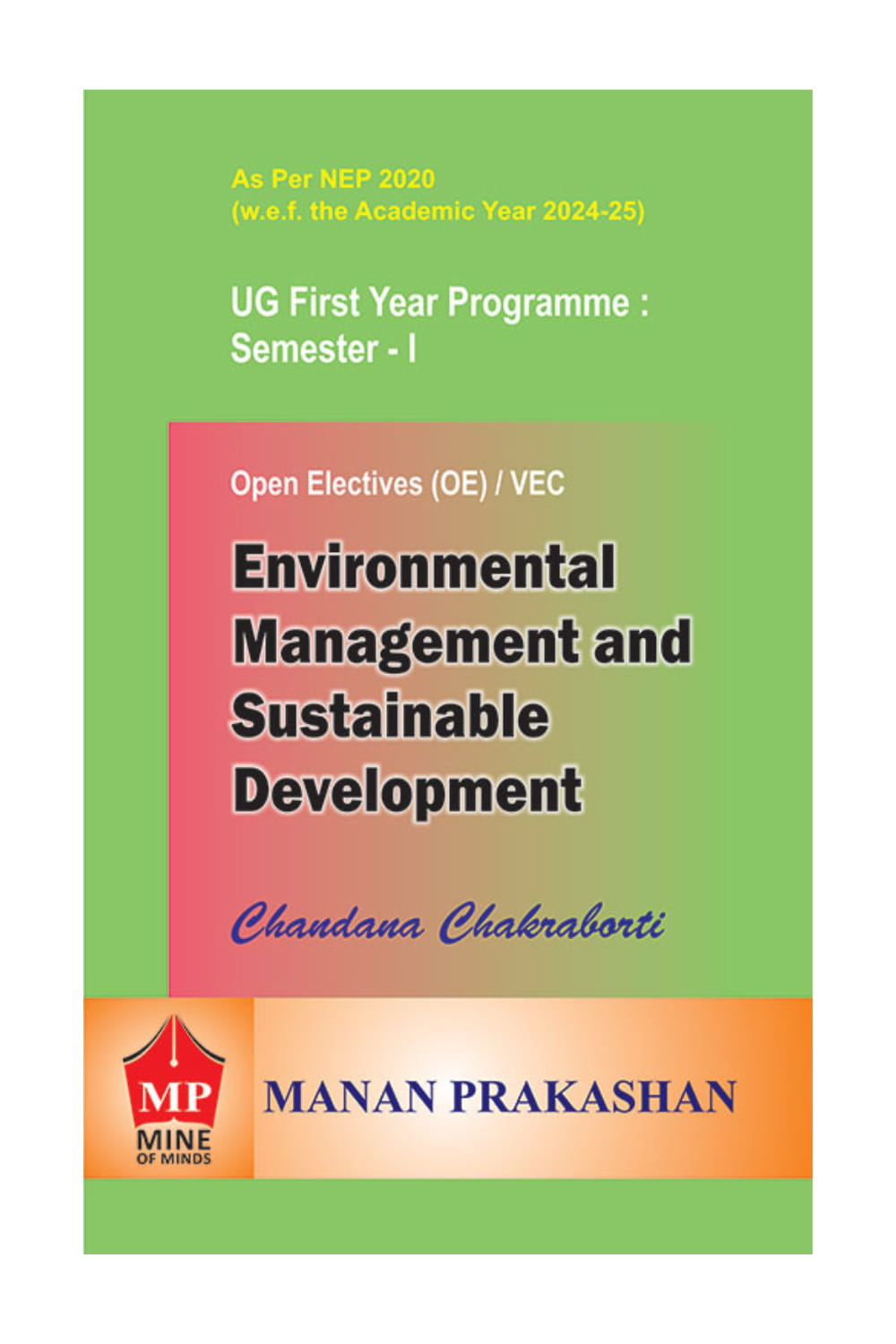
Environmental Management and Sustainable Development – I – UG First Year Programme Semester I
₹180.00
Buy Now
In Stock
Prof. (Mrs.) Chandana Chakraborti
Second Revised Edition – July 2026
Categories: Arts, Arts Semester 1, B.A.F., B.B.I., B.B.I. Semester I, B.M.S., B.M.S. Semester 1, BAF Semester 1, Books, Commerce Degree, Commerce Semester 1, F.Y. BCom, F.Y.B.A., FYBAF, FYBBI, FYBMS, Self Finance Degree
Description
Environmental Management and Sustainable Development – I
Value Education Course (VEC) / Open Electives (OE)
UG First Year Programme Semester – I
Syllabus (As per NEP 2020) w.e.f. the Academic year 2025-2026
Unit I : Ecosystems, Biodiversity and Conservation (8 Lectures)
Introduction, Structure, and Function of Ecosystems; Energy Flow: Food Chains, Food Webs and Ecological Succession. Case Studies of the following:
(a) Forest Ecosystem
(b) Grassland Ecosystem
(c) Desert Ecosystem
(d) Aquatic Ecosystems (Ponds, Streams, Lakes, Rivers, Oceans, Estuaries)
1. Levels of Biological Diversity : Genetic, Species and Ecosystem Diversity; Biogeographic Zones of India; Biodiversity Patterns
2. India as a Mega-Biodiversity Nation; Endangered and Endemic Species of India
3. Threats to Biodiversity : Habitat Loss, Poaching of Wildlife, Man-Wildlife Conflicts, Biological Invasions; Conservation of Biodiversity : In-situ and Ex-situ Conservation of Biodiversity
4. Ecosystem and Biodiversity Services: Ecological, Economic, Social, Ethical, Aesthetic and Informational Value
Unit II : Natural Resources and Sustainable Development (7 Lectures)
♦ Overview of Natural Resources: Definition of Resource; Classification of Natural Resources – Biotic and Abiotic, Renewable and Non-Renewable.
♦ Biotic Resources: Major Type of Biotic Resources – Forests, Grasslands, Wetlands, Wildlife and Aquatic (Fresh Water and Marine); Microbes as a Resource; Status and Challenges.
♦ Water Resources: Types of Water Resources – Fresh Water and Marine Resources; Availability and Use of Water Resources; Environmental Impact of Over-exploitation, Issues and Challenges; Water Scarcity and Stress; Conflicts over Water.
♦ Soil and Mineral Resources: Important Minerals; Mineral Exploitation; Environmental Problems due to Extraction of Minerals and Use; Soil as a Resource and its Degradation.
♦ Energy Resources: Sources of Energy and their Classification, Renewable and Non-Renewable Sources of Energy; Conventional Energy Sources – Coal, Oil, Natural Gas, Nuclear Energy;
Non-Conventional Energy Sources – Solar, Wind, Tidal, Hydro, Wave, Ocean Thermal, Geothermal, Biomass, Hydrogen and Fuel Cells; Implications of Energy Use on the Environment.
♦ Introduction to Sustainable Development: Sustainable Development Goals (SDGs) – Targets and Indicators, Challenges and Strategies for SDGs.
Unit III : Human Communities and the Environment (8 Lectures)
1. Human Population Growth: Impacts on Environment, Human Health and Welfare.
2. Resettlement and Rehabilitation of Project Affected Persons; Case Studies.
3. Disaster Management: Floods, Earthquake, Cyclones and Landslides.
4. Environmental Movements: Chipko, Silent Valley, Bishnois of Rajasthan.
5. Environmental Ethics: Role of Indian and other Religions and Cultures in Environmental Conservation.
6. Environmental Communication and Public Awareness, Case Studies (e.g. CNG Vehicles in Delhi).
Unit IV : Environmental Issues : Local, Regional and Global (7 Lectures)
♦ Environmental Issues and Scales: Concepts of Micro-, Meso-, Synoptic and Planetary Scales; Temporal and Spatial Extents of Local, Regional, and Global Phenomena.
♦ Pollution: Impact of Sectoral Processes on Environment, Types of Pollution – Air, Noise, Water, Soil, Municipal Solid Waste, Hazardous Waste; Transboundary Air Pollution; Acid rain; Smog.
♦ Land Use and Land Cover Change: Land Degradation, Deforestation, Desertification, Urbanization.
♦ Biodiversity Loss: Past and Current Trends, Impact.
♦ Global Change: Ozone Layer Depletion; Climate Change.
Related products



Recently viewed items
12%

Reviews
There are no reviews yet.